
India's services sector growth eased slightly in April but growth of new business and output remained sharp and among the fastest in 14 years amid favourable economic conditions and strong demand, a monthly survey said on Monday. The seasonally adjusted HSBC India Services Business Activity Index fell from 61.2 in March to 60.8 in April, highlighting one of the strongest growth rates seen in just under 14 years. Survey members attributed the latest upturn in output to favourable economic conditions, demand strength and rising intakes of new work.

The current spurt in the stock market is on account of strong fundamentals and robust corporate earnings and retail investors can look for buying opportunities to accumulate quality stocks, experts said.

The Purchasing Managers Index (PMI) of China's manufacturing sector rose to 53.8 per cent in September, up 2.1 percentage points from August, the China Federation of Logistics and Purchasing said on Friday.
The services sector growth in India moderated in February amid softer expansions in business activity, sales and jobs, a monthly survey said on Tuesday. The seasonally adjusted HSBC India Services Business Activity Index registered 60.6 in February, down from 61.8 in January. In Purchasing Managers' Index (PMI) parlance, a print above 50 means expansion, while a score below 50 denotes contraction.

India's services sector witnessed one of the strongest growth rates in over 13-and-a-half years in March on the back of strong demand that spurred sales and business activity, a monthly survey said on Thursday. The seasonally adjusted HSBC India Services Business Activity Index rose from 60.6 in February to 61.2 in March, one of the strongest expansions in total sales and business activity in close to 14 years. In the Purchasing Managers' Index (PMI) parlance, a print above 50 means expansion, while a score below 50 denotes contraction.

The services sector growth in India rose to a six-month high in January as new business expanded at a faster pace amid buoyant demand from domestic and external clients, a monthly survey said on Monday. The seasonally adjusted HSBC India Services PMI Business Activity Index rose to 61.8 in January, up from 59 in December, pointing to the sharpest rate of expansion in six months.

JSW Steel (3.37 per cent), Tata Steel (3.33 per cent), Maruti (3.24 per cent), Power Grid (3.07 per cent), IndusInd Bank (2.95 per cent), Bajaj Finance (2.12 per cent) and Tech Mahindra (2.22 per cent) were among major gainers. On the other hand, Ultratech Cement, Sun Pharma, Nestle and L&T were the losers.
The headline seasonally adjusted IHS Markit India Manufacturing Purchasing Managers' Index (PMI) fell to a two-year low of 50.6 in October from 51.4 in September.

Days before Diwali, the monthly economic review by the finance ministry has highlighted moderation in urban demand, softening consumer sentiments and limited footfall as areas that need to be watched. In its review, released on Monday, the ministry also noted the early signs of artificial intelligence displacing workers, as described in anecdotal reports. The commentary from several large consumer goods companies, including Nestl India, Hindustan Unilever, and ITC, in their recent quarterly earnings, has been around a sluggish urban demand. Rural consumption, however, has mostly seen a revival, the companies pointed out.

If growth reverts to the pre-Covid level, a lot of people may have to temper their rosy optimism, points out Debashis Basu.

PMI increased from 52.0 in August to 56.8 in September -- highest since January 2012.

The services sector growth in India rose to a three-month high in December supported by favourable economic conditions and positive demand trends, a monthly survey said on Friday. The seasonally adjusted HSBC India Services PMI Business Activity Index rose from 56.9 in November to 59 in December, highlighting a sharp increase in output that was the most pronounced since September. In Purchasing Managers' Index (PMI) parlance, a print above 50 means expansion while a score below 50 denotes contraction.

India's services sector remained in contraction territory for the third straight month in July, as business activity, new orders and employment declined further largely due to the COVID-19 pandemic and local restrictions, a monthly survey said on Wednesday. The seasonally adjusted India Services Business Activity Index rose from 41.2 in June to 45.4 in July, but was stuck in the red due to subdued demand conditions amid the COVID-19 crisis. In Purchasing Managers' Index (PMI) parlance, a print above 50 means expansion, while a score below 50 denotes contraction.
From the Sensex basket, Power Grid, Asian Paints, Tata Motors, Tata Steel, NTPC, Sun Pharma, Mahindra & Mahindra, HDFC Bank, Tata Consultancy Services and JSW Steel were among the major gainers. Kotak Mahindra Bank, Bharti Airtel, Axis Bank, Wipro, ICICI Bank and IndusInd Bank were among the laggards.

Trading activity of foreign investors and global trends will be the major driving factors for the equity markets in a holiday-shortened week ahead, according to analysts. Leading stock exchanges BSE and NSE have declared a trading holiday on November 20 for assembly elections in Maharashtra. Elections to the 288-member state legislative assembly will be held on November 20, and votes will be counted on November 23.

New business received by Indian manufacturers expanded at the fastest pace since February.


PMI went up from 51.2 points in May to 53.1 in June. Owing to the June figure, PMI for manufacturing stood at 51.9 points in the first quarter of 2018-19 against 51.8 points in the fourth quarter of 2017-18.

Investors' wealth climbed Rs 3.20 lakh crore as markets staged a smart comeback on Wednesday after falling in the last eight trading sessions. The BSE Sensex rallied 448.96 points or 0.76 per cent to settle at 59,411.08. During the day, it jumped 513.33 points or 0.87 per cent to 59,475.45.

New businesses have been secured from the public and private sectors, as well as domestic and international markets.

The mismatch between PMI and core sector could also be due to the fact that while core sector is calculated year-on-year, PMI is calculated month-on-month.
The headline seasonally adjusted IHS Markit India Manufacturing Purchasing Managers' Index (PMI) fell to 27.4 in April, from 51.8 in March, reflecting the sharpest deterioration in business conditions across the sector since data collection began over 15 years ago. The index slipped into contraction mode, after remaining in the growth territory for 32 consecutive months. In PMI parlance, a print above 50 means expansion, while a score below that denotes contraction.
India's manufacturing sector activities witnessed the strongest rate of growth in three months in July amid improved demand conditions and easing of some local COVID-19 restrictions, a monthly survey said on Monday. The seasonally adjusted IHS Markit India Manufacturing Purchasing Managers' Index (PMI) rose from 48.1 in June to 55.3 in July, pointing to the strongest rate of growth in three months. In PMI parlance, a print above 50 means expansion while a score below 50 denotes contraction.

The Nikkei India Manufacturing Purchasing Managers Index (PMI), fell from 52.1 in February to a five-month low of 51.0 in March, indicating the slowest improvement in operating conditions recorded by the survey since last October.

Firms hired additional hands to keep up with the production demand
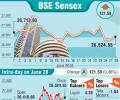
The S&P BSE Sensex gained 122 points to end at 26,525.

The Nikkei India Manufacturing Purchasing Managers' Index (PMI) stood at 47.9 in July, down from 50.9 in June, its lowest mark since February 2009, and highlighted the first deterioration in business conditions in 2017 so far.
The services sector growth in India fell to a one-year low in November on softer expansions in new work intakes and output, despite receding price pressures, a monthly survey said on Tuesday. The seasonally adjusted S&P Global India Services Business Activity Index fell from 58.4 in October to a one-year low of 56.9 in November. Despite witnessing a month-on-month decline, the rate of expansion was stronger than its long-run average.

India's manufacturing sector activities lost further growth momentum and fell to a seven-month low in March as demand was constrained by the escalation of the COVID-19 pandemic, a monthly survey said on Monday. The seasonally adjusted IHS Markit India Manufacturing Purchasing Managers' Index (PMI) fell from 57.5 in February to a seven-month low of 55.4 in March. However, the latest reading was indicative of a substantial improvement in the health of the sector that outpaced the long-run series average, it said. In PMI parlance, a print above 50 means expansion while a score below 50 denotes contraction.

The index has remained above the 50-mark, below which it indicates contraction, for more than three years now.

From the Sensex pack, State Bank of India, Axis Bank, IndusInd Bank, Tech Mahindra, HCL Technologies, Tata Consultancy Services, Maruti Suzuki, Tata Steel and Tata Motors were the major gainers. Power Grid and HDFC Bank were the laggards from the pack.

India's manufacturing sector activities eased slightly in February but firms were upbeat as they responded to increased new work intakes by stepping up production and purchasing activities, a monthly survey said on Monday. The seasonally-adjusted IHS Markit India Manufacturing Purchasing Managers' Index (PMI) fell marginally to 57.5 in February from 57.7 in January, indicating that even though the pace of growth eased from January it remained sharp in the context of historical data. The headline figure for February remained above its long-run average of 53.6, the survey noted. In PMI parlance, a print above 50 means expansion while a score below 50 denotes contraction.

Equity investors will track the trading activity of foreign investors, global trends and ongoing earnings results for further cues, and benchmark indices may continue to witness consolidation in a holiday-shortened week amid the monthly derivatives expiry, analysts said. Markets fell sharply last week amid massive foreign capital outflows and dismal Q2 earnings so far. Weakness in the markets might continue in the near term amid cautiousness among investors ahead of the US presidential election early next month, an expert said.

"Any lingering concern that India's manufacturing recovery was tailing off should be put off. A second consecutive rise in PMI has taken the series to a new cycle high consistent on double digit rise in industrial production," said Robert Prior Wandesforde, senior asian economist, HSBC.

Investor wealth eroded by Rs 4.46 lakh crore in a single day on Friday with the benchmark BSE Sensex tanking more than 1 per cent in line with global stocks rout. The 30-share BSE Sensex plunged 885.60 points or 1.08 per cent to close at 80,981.95 with 25 of its components declining and five ending with gains. During the day, it nosedived 998.64 points or 1.21 per cent to hit an intra-day low of 80,868.91.
The Chinese economy is headed for troubled waters, with its manufacturing sector shrinking in November for the first time in nearly three years, in a fresh sign of a further economic slowdown that may prompt it to loosen its monetary policy.
Services sector activities in India picked up marginally in February on the back of better demand conditions and the retreat of the coronavirus pandemic but the rate of expansion was the second-slowest since last July and subdued by historical standards, according to a monthly survey. Reflecting a moderate rate of expansion, the seasonally adjusted IHS Markit India Services Business Activity Index rose to 51.8 in February from 51.5 in January. "The upturn was attributed by panellists to greater bookings, better demand conditions and the retreat of the pandemic. "That said, the latest increase was subdued by historical standards, with some companies indicating that growth was dampened by competitive pressures, COVID-19 and higher prices," the survey released on Friday said.

The Nikkei Markit India Manufacturing Purchasing Managers' Index (PMI) -- an indicator of manufacturing activity -- declined from 52.5 in April to a three-month low of 51.6 in May.

The Reserve Bank of India's (RBI's) State of the Economy report for October acknowledged a slowdown in some high-frequency indicators but expressed confidence in a recovery, aided by consumption demand during the festival season. "In India, aggregate demand is poised to shrug off the temporary slowdown in momentum in the second quarter of 2024-25 as festival demand picks up pace and consumer confidence improves," said the report released on Monday.
Macroeconomic data announcements, global trends and trading activity of foreign investors would guide momentum in the equity market this week, analysts said. Markets ended a five-week losing streak and gained nearly a per cent last week, helped by a sharp rebound on Friday. Last week, the BSE benchmark jumped 500.65 points or 0.77 per cent and the Nifty gained 169.5 points or 0.87 per cent.
 © 2026 Rediff.com - Advertise with us - Disclaimer - Privacy Policy - Sitemap - Feedback - About us - Terms of use - Grievances